
Understanding Christmas Tree Reticles
Posted by Monstrum on Aug 7th 2026
Of all the many types of scope reticles that are currently sold, Christmas Tree reticles are easily the most complex, but for those who know how to use them, they can also be the most capable.
If you’ve ever wondered how Christmas Tree Reticles work, you’re in the right place. We’ll explain everything you want to know about them in this guide.
What are Christmas Tree Reticles?
Christmas tree reticles are scope reticles that add lateral markings for wind holds in addition to bullet drop markings resulting in triangular pattern of markings that gets wider the further down from the center point of the reticle in a shape that vaguely resembles a christmas tree. Each of these markings are set at regular intervals of either minute of angle (MOA) or milliradians (MRAD).
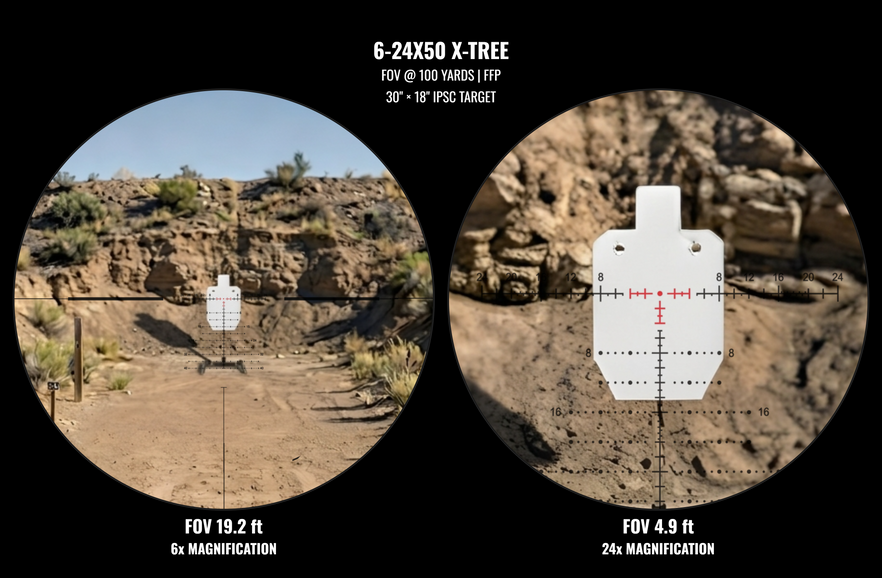
Christmas tree reticles can be thought of as a ruler grid but measuring angle instead of distance. They are designed to provide a shooter quick reference points for bullet drop and wind deflection at known distances. Christmas tree reticles can take some of the guesswork out of holdover by helping visualize how a wind of known speed and direction should deflect a bullet’s flight path, but for inexperienced shooters, they can also be difficult to understand and use effectively because of their complexity.
Because of the Christmas tree reticles are designed to be used, they are almost exclusively found in first focal plane (FFP) scopes. This is because the markings must be accurate and usable at any magnification level.
How Wind Deflection Works
Ask any long range precision shooter which variable is the hardest to predict accurately and they will probably say wind. Wind is a variable that is both difficult to read and constantly changing both in speed and direction, and if that wasn’t hard enough to deal with, over extreme distances, it can also be moving at different speeds or varied directions over the course of a bullet’s flight path.
When shooters adjust for wind deflection, they have to account for both speed and direction. A 10 mph wind blowing at a perfectly 90 degree angle to a bullet’s flight path is considered to have a full value. If that same wind were blowing at 45 degree angle, it would be considered to have a half value. Taking into account speed, direction, and a host of other factors including bullet weight, barrel length, and others, shooters will come up with a number in either MOA or MRAD for how much wind deflection their bullet will face along its flight path. Once they have this number, Christmas tree reticles make holding over a simple matter of lining up your target on the correct marking.
Christmas Tree Reticle Markings
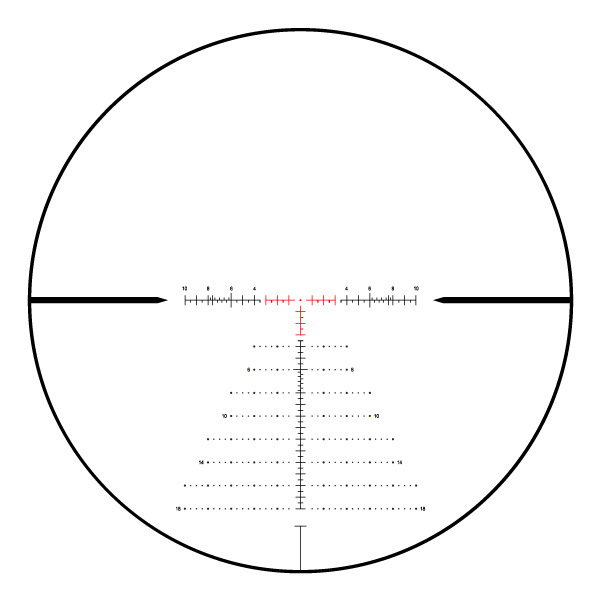
Before we dive into how to use Christmas tree reticles, we should first explain each of the markings they have:
Center Crosshair
As with any scope, the center aiming point shows where your bullet will impact at its zero distance with no wind drift. Zeroing is an important first step in understanding your holdover markings because it changes where they fall based on where your optic is initially zeroed.
Vertical Line
Directly below your Crosshair, there is a vertical line dropping toward the center bottom of your optic. This is considered the trunk of the christmas tree and is usually marked with the same angular unit of measurement as your cross hair and wind holds either MOA or MRAD.
Horizontal Branches
Lastly, we have horizontal branches extending outward from your BDC markings from the center line. These are used to hold over for wind drift.
How to use Christmas Tree reticles
Depending on what your preferred unit of measurement is, Christmas tree reticles are calibrated either for MOA or MRAD measurements. In order to use them effectively, you have to know how much bullet drop and wind deflection your ammo load will face, then work out how much you need to hold over based on current wind conditions and range, and finally hold over based on your calculations and send it.
To give an example of how this is all put together, let’s say you’re shooting a .308 rifle with our Hornet II 6-24x50 FFP rifle scope at a distance of 500 yards. The rifle being zeroed at 100 yards should drop roughly 3.3 MRAD at 500 yards, so you would first hold the center aiming point of your reticle roughly 3.3 MRAD over your target. Let’s also assume you have a full value 5 mph crosswind blowing. At 500 yards, this should push your bullet off course by about 9.5 inches, working backward that translates to 0.5 MRAD.
To hit your mark in this scenario, you would simply hold your reticle over so that you are 3.3 MRAD over and 0.5 MRAD across aiming into the wind. Assuming your math was good and both your range estimation and wind calculations are accurate, your bullet should hit its mark.
* Disclaimer, these are hypothetical numbers for illustrative purposes only. Actual ballistic calculations will vary depending on your caliber specific ammo load and should factor in other variables such as angle to the target and air pressure. You can usually find load-specific ballistic data on your ammo manufacturer’s website or on the ammo box itself.
What You Need to Know to Use Christmas Tree Reticles Effectively
Before you can get the most out of your christmas tree reticle scope, you must first understand a few key factors:
1. MOA and MRAD calculations
Your scope will use one of these two systems for holdover markings, so you should know how to convert inches into one or both of these two units at any distance.
2. Your Firearm and Bullet Specifications
Even within the same caliber, different barrel lengths and bullet types and weights will have varied bullet drop and wind drift at different distances.
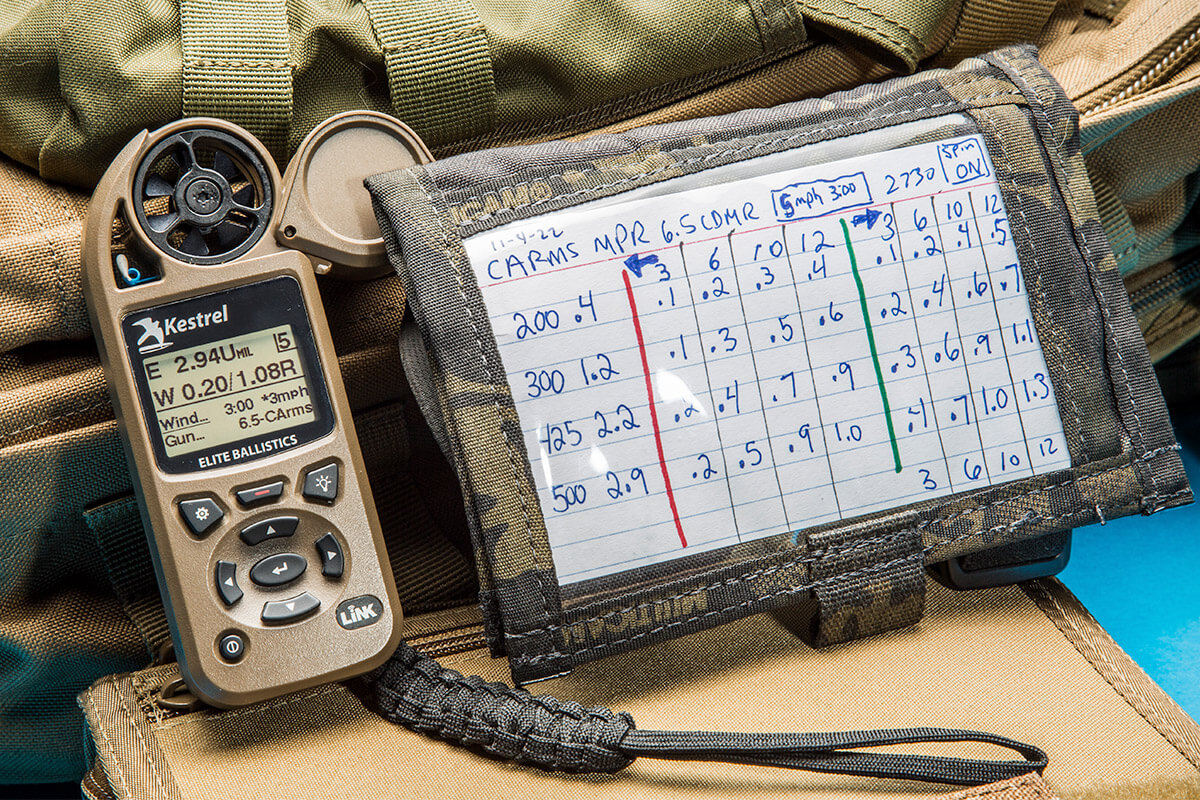
3. Wind Speed and Direction
Ideally, you should have a tool to accurately calculate wind speed at your location, but if not, you should also have a basic understanding of what a 3, 5, or 10mph wind looks and feels like.
Once you have credible and accurate information for all of the above, you’re ready to use your Christmas tree reticle.
Conclusion
Christmas tree reticles can be a fast option for quickly and accurately holding over in windy conditions, but they require the user to have a high degree of prerequisite knowledge of how their specific bullet weight and barrel length should behave under given circumstances.
Experienced shooters who know their equipment well can expect to make fast hits at virtually any range provided than can accurately estimate distance, wind speed, and direction.
If you’re looking for an affordable rifle scope with Christmas Tree reticle, check out our full line of long range rifle scopes with plenty of options for Christmas Tree reticles available.
Look for the X-Tree MOA or X-Tree MIL reticles on the Hornet, Challenger, and Beast series.